Sub-Total: $0.00

Have questions about this assay kit?
Human NF-kB Reporter Assay Kit
Product Description and Product Data
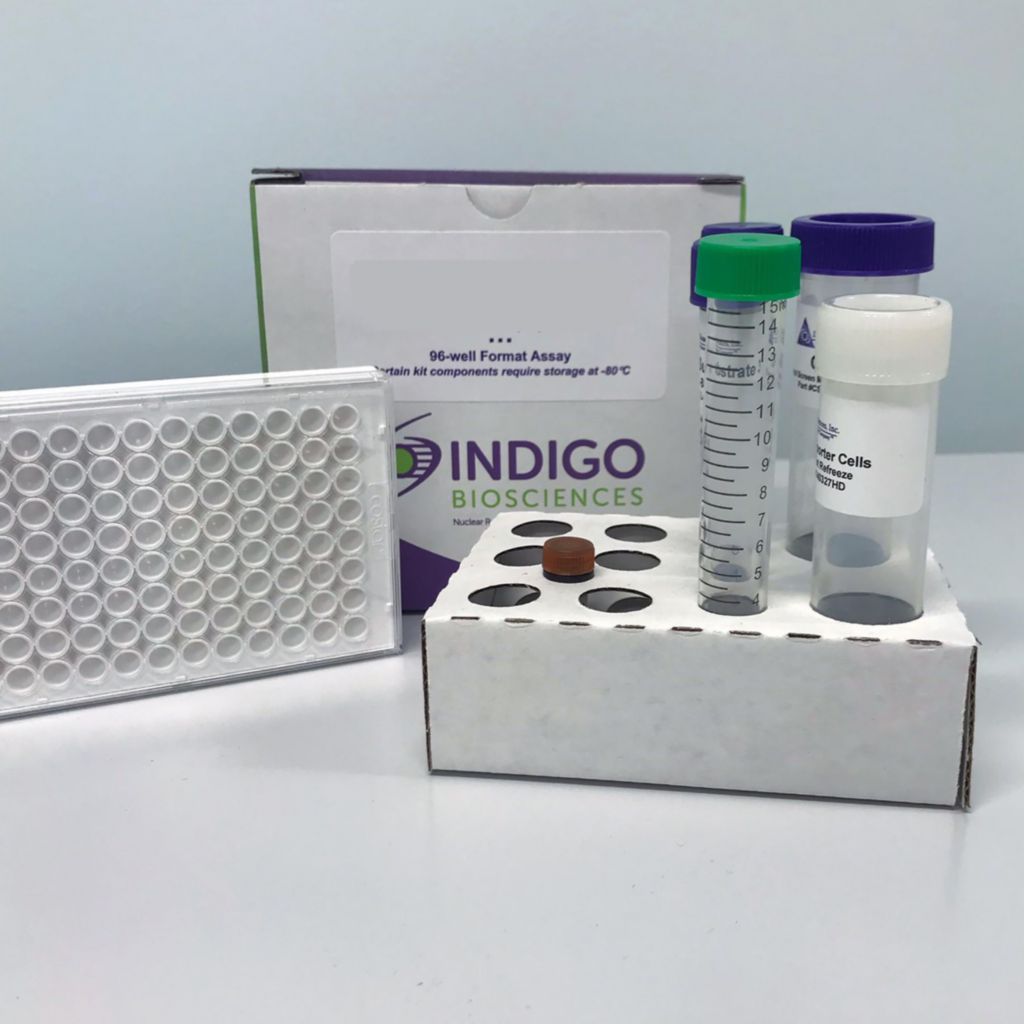
This is an all-inclusive cell-based luciferase reporter assay kit targeting the Human Nuclear Factor kappa-light-chain enhancer of activated B cells (NF-kB). INDIGO’s NF-kB reporter assay utilizes proprietary mammalian cells that have been engineered to provide constitutive expression of NF-kB. In addition to NF-kB Reporter Cells, this kit provides two optimized media for use during cell culture and in diluting the user’s test samples, a reference agonist, Luciferase Detection Reagent, and a cell culture-ready assay plate. The principal application of this assay is in the screening of test samples to quantify any functional activity, either agonist or antagonist, that they may exert against human NF-kB. This kit provides researchers with clear, reproducible results, exceptional cell viability post-thaw, and consistent results lot to lot. Kits must be stored at -80C. Do not store in liquid nitrogen. Note: reporter cells cannot be refrozen or maintained in extended culture.
Features
Clear, Reproducible Results
- All-Inclusive Assay Systems
- Exceptional Cell Viability Post-Thaw
- Consistent Results Lot to Lot
Product Specifications
| Target Type | Transcription Factor | ||
| Species | Human | ||
| Receptor Form | Native | ||
| Assay Mode | Agonist, Antagonist | ||
| Kit Components |
| ||
| Shelf Life | 6 months | ||
| Orthologs Available | No | ||
| Shipping Requirements | Dry Ice | ||
| Storage temperature | -80C |
Data
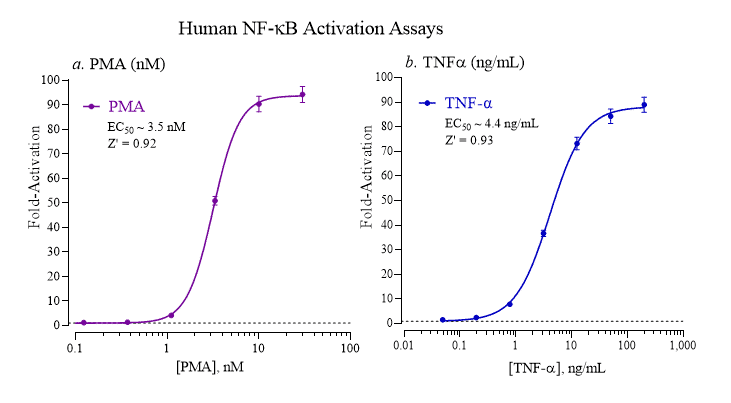
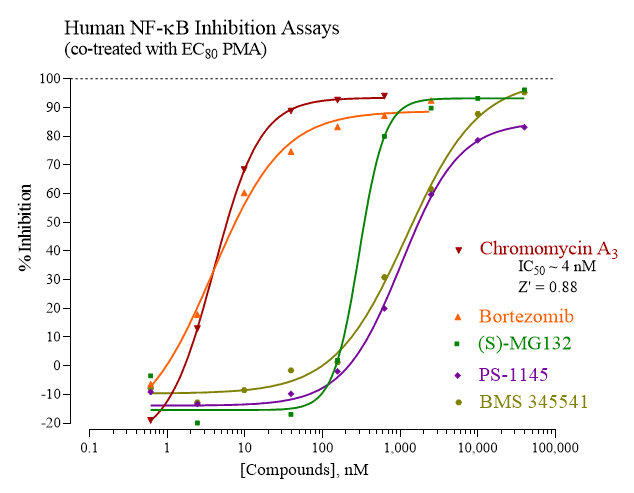
Target Background
NF-kB is a signal transduction dependent transcription factor. INDIGO’s Human NF-kB Reporter Assay System utilizes proprietary human cells that express NF-kB (nuclear factor kappa-light-chain enhancer of activated B Cells), and contain the luciferase reporter gene functionally linked to upstream NF-kB genetic response elements. Thus, quantifying changes in luciferase expression provides a sensitive surrogate measure of changes in the level of NF-kB activation. This NF-kB reporter cell line is validated to provide a robust dose-dependent activation response when treated with TNFa, or the Protein Kinase C activator Phorbol 12-myristate 13-acetate (PMA). As such, the principle application of this assay system is in the screening of test samples to quantify any functional activities that they may exert to modulate, either induce or suppress, NF-kB activities.
Citations

SARS-CoV-2 infection still poses health threats especially to older and immunocompromised individuals. New emerging variants of SARS-CoV-2, including Omicron and Arcturus, have been challenging the effectiveness of humoral immunity resulting from repeated vaccination and infection. With recent study implying a wave of new mutants in vaccinated people making them more susceptible to the newest variants and fueling a rapid viral evolution, there is a need for alternative or adjunct approaches against coronavirus infections other than vaccines. Our earlier work indicated that a specific combination of micronutrients and phytochemicals can inhibit key infection mechanisms shared by SARS-CoV-2 and its variants in vitro. Here we demonstrate in vivo that an intake of this micronutrient combination before and during infection of mice with engineered SARS-CoV-2 virions and HCoV-229E virus results in a significant decrease in viral load and level of spike protein in the lungs. This was accompanied by decreased inflammatory response, including TNFα, IL1β, ILα, and IL17. These and our earlier results confirm that by targeting multiple mechanisms simultaneously by a combination treatment we can effectively and safely challenge SARS-CoV-2 and HCoV-229E virus. If clinically confirmed, such an approach could complement already in-use preventive and therapeutic strategies against coronavirus infections.
The cases of Lyme disease caused by Borrelia burgdorferi infection have been increasing throughout Northern America and Europe. This pathogen, if not treated in a timely manner with antibiotics, can cause persisting and debilitating health outcomes. In the search for novel agents against B. burgdorferi, we investigated a phenolic compound—gallic acid—for its anti-Borrelia and anti-inflammatory effects. Our results showed its biocidal effect starting from 100 μg/mL against active spirochetes, persisters/round-shaped bodies, and biofilm like aggregates of B. burgdorferi sensu stricto. Activation of macrophages by live B. burgdorferi also resulted in a robust NFκB-dependent proinflammatory responses seen in increased production of cytokines. Using human CD14+ macrophages in vitro, we showed that CD14+ adaptor and phosphorylated p65 molecule are impeded at nonbiocidal and noncytotoxic concentrations of gallic acid, resulting in the inhibition of both expression and secretion of cytokines IL1β, IL6, and TNFα. Our findings demonstrate efficacy of gallic acid against B. burgdorferi and provide potential mechanistic insight into its TLR2/CD14+-NFκB mediated mode of action. Further studies on the potential of gallic acid as a safe and effective compound against Borrelia-caused infection are warranted.
Citations
Also available as a service
